
Quick answers from this guide
Quick answers from this guide
Who is this guide best for?
This guide is best for seafarers who want clearer next steps before applying, especially when they need stronger context around documents, employer targeting, role fit, or career direction.
How should I use this guide?
Use the advice here together with live jobs, company pages, and related role or fleet hubs so you can turn general research into a more targeted application plan.
What should I open next after this guide?
Open the related ship job searches, company research pages, and connected guides linked below so you can move from reading into live opportunities and better-fit employers.
Marine engineer career path at sea
Marine engineer career path at sea
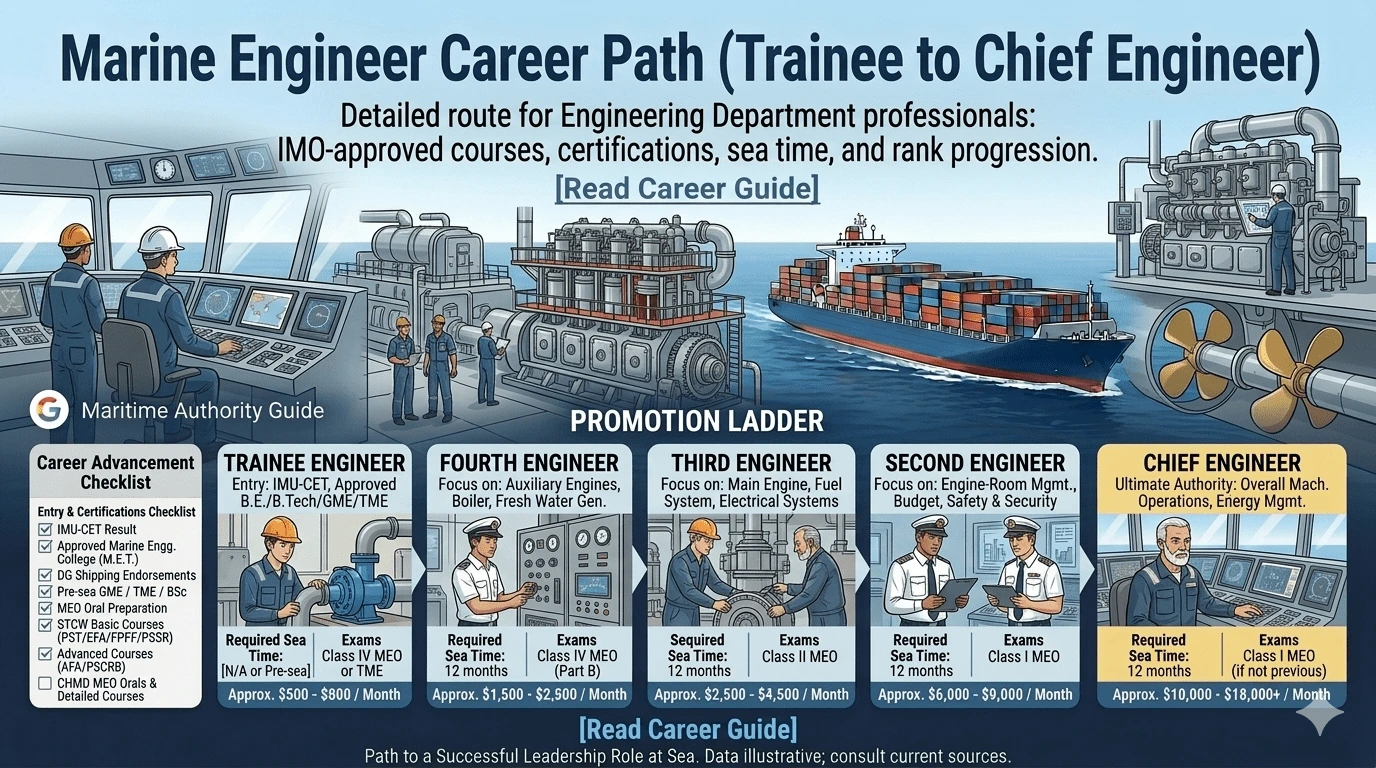
Marine engineering careers usually begin with engine cadet or trainee pathways and then progress through 4th engineer, 3rd engineer, 2nd engineer, and chief engineer roles. The exact timeline depends on sea time, exams, company standards, endorsements, vessel type, and whether you build stable experience in one fleet segment or move between several.
The higher you move, the more your job changes from learning and execution to planning, supervision, fault response, spare management, audits, dry-dock preparation, and team leadership. That is why companies do not only evaluate certificates. They also look at how broad and relevant your engine-room exposure really is.
Skills companies expect at different levels
Skills companies expect at different levels
Junior engineers are usually assessed on watchkeeping fundamentals, maintenance discipline, safety awareness, and whether they understand core systems such as pumps, purifiers, compressors, auxiliary machinery, bunkering support, and planned maintenance workflows. Clear logbook habits and a calm approach to learning matter a lot at this stage.
Senior engineers are judged more heavily on troubleshooting, machinery reliability, class and audit readiness, spare and inventory control, dry-dock planning, leadership, and communication with shore teams. If you want faster promotion, start building these habits before your certificate level requires them.
How to build a stronger engineering CV
How to build a stronger engineering CV
A strong marine engineer CV should clearly show rank, certificate level, ship types, engine type exposure, total sea time, recent contracts, and the systems or operational responsibilities you handled. Generic lines like responsible for maintenance are weak on their own. Recruiters respond better when they see specifics such as purifier overhaul, boiler work, auxiliary engine troubleshooting, PMS execution, or dry-dock participation.
If you have LNG, tanker, offshore, automation, ECR, high-voltage, or electronically controlled engine exposure, make that visible. These are the kinds of details that can change whether your CV is shortlisted for a specialist fleet or skipped in favor of someone whose experience is easier to understand.
How promotion really happens
How promotion really happens
Promotion in marine engineering is not only about sea time and passing exams. Companies often promote people who already behave like the next rank: they keep reliable records, communicate clearly, handle responsibility calmly, and understand both machinery and team workflow. Your reputation from previous contracts matters more than many candidates realize.
If you want promotion, ask yourself whether your current contract is helping you build relevant next-rank evidence. For example, a 4th engineer who wants to move up should pay attention to planned maintenance ownership, troubleshooting participation, and documentation quality, not just daily routine tasks.
How to choose the right employers and fleets
How to choose the right employers and fleets
Not every company is equally useful for long-term engineering growth. Some fleets provide strong machinery exposure, structured promotion paths, and predictable contract patterns. Others may offer faster joining but weaker long-term development. Try to balance immediate job needs with where the contract positions you for the next one.
Before applying, compare fleet type, engine-room complexity, contract length, and whether the company appears to rehire and promote engineers. Job pages and company profiles together can help you judge whether a role fits your current rank and where you want your engineering career to move next.
Common mistakes marine engineers should avoid
Common mistakes marine engineers should avoid
A frequent mistake is applying too broadly without aligning certificate level and vessel exposure to the role. Another is submitting a CV that only lists ranks and ship names without showing systems knowledge or operational relevance. Recruiters often reject capable engineers simply because their profile is unclear, not because their experience is weak.
Avoid overstating technical ability in interviews. It is safer to explain what you have actually handled, what you supported, and what you are ready to learn next. Companies value engineers who are honest, structured, and dependable under pressure. Those qualities are usually more hireable than exaggerated confidence.
Research the next engineering move
Research the next engineering move
Priority ship job hubs
Priority ship job hubs
Related ship job searches
Related ship job searches
Related maritime guides
Related maritime guides
Guide FAQ
What does this guide help with?
A clear overview of the engine-room career path, promotion ladder, and hiring expectations.
Who should read this Marine engineer career guide?
This page is useful for seafarers, cadets, engineers, ratings, and maritime job seekers who want clearer research and application guidance before they apply.
Is this guide more useful for junior or senior marine engineers?
It helps both, but it is especially valuable for engineers thinking about progression because it connects certificate level, machinery exposure, fleet relevance, and next-rank planning.
What should marine engineers do after reading this guide?
Use the linked job hubs, offshore pathways, and employer pages to compare whether your current engine-room experience matches the fleet and role you actually want next.
How should I use this Marine engineer career guide more effectively?
Use this guide together with the related job pages, company profiles, and connected role or fleet hubs so you can turn general advice into a stronger application plan.
What should I open after reading this guide?
Use the related job pages, company pages, and connected maritime guides linked on this page to continue from research into live job discovery and better-targeted applications.
Primary references
Use these official sources to verify regulatory and document requirements. Employer-specific requirements can differ by flag, rank, vessel, and hiring country.
Next steps